
You’re the best trainer in your city. Your clients get incredible results. But when someone Googles “personal trainer [your city],” you’re nowhere to be found.
Meanwhile, the trainer down the street with half your expertise is booked solid because they show up first on Google Maps. That’s the brutal reality of local search: the best trainer doesn’t always win. The most visible one does.
Local SEO (Search Engine Optimization) is how you fix this. It’s the process of making sure when people in your area search for fitness services, Google shows them your business, not your competitors’. This guide breaks down exactly how to dominate local search results and fill your client roster with people actively looking for trainers near them.
Contents:
- 1. Why local SEO matters more than you think
- 2. Google Business Profile: your most important asset
- 3. Optimizing your website for local search
- 4. Building local citations and directory listings
- 5. Generating and managing client reviews
- 6. Creating location-specific content
- 7. Local link building strategies
- 8. Mobile optimization for local search
- 9. Tracking your local SEO performance
- 10. Common local SEO mistakes to avoid
Why local SEO matters more than you think
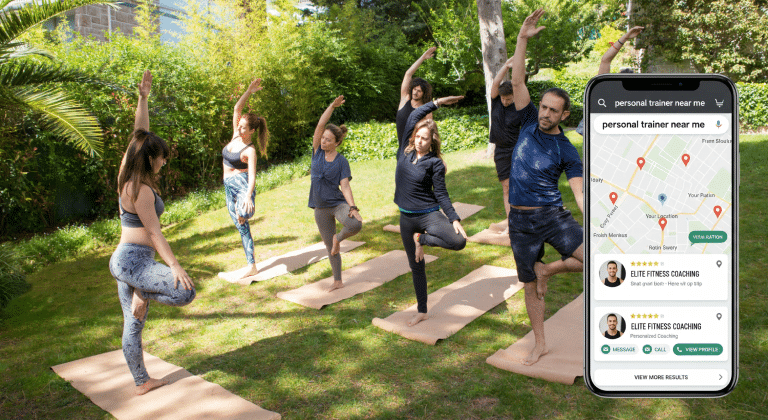
Personal training can be an incredibly localized industry, especially if you’re an in-person only coach. Even if you offer online coaching as part of your service offering, many trainers rely heavily on clients within driving distance.
The local search opportunity
46% of all Google searches have local intent, i.e. people looking for businesses near them. When someone searches “personal trainer near me” or “best gym in [city],” they’re not browsing. They’re ready to hire someone.
These searchers convert at significantly higher rates than general fitness content readers. They have immediate need, specific location and purchase intent. That means you just need to be visible when they search.
Your competition probably isn’t optimizing
Many personal trainers ignore local SEO entirely. They post on Instagram, maybe have a website, and wonder why new clients don’t find them.
This creates massive opportunity. Basic local SEO optimization can leapfrog you over competitors who’ve been in business longer, but who never mastered how search engines work
The compound effect
Local SEO improvements compound over time. Every review, every citation, every optimized page strengthens your overall visibility. Six months of consistent effort creates momentum that keeps bringing clients with minimal ongoing work.
For broader context on lead generation strategies for personal trainers, local SEO should be a cornerstone of your marketing approach.
Google Business Profile: your most important asset

If you do nothing else from this guide, set up and optimize your Google Business Profile (formerly Google My Business). This free tool controls how you appear in Google Maps and local search results.
Creating your profile
Step 1: Claim your business
- Go to google.com/business
- Search for your business name
- If it exists, claim it; if not, create new listing
- Verify ownership (typically via postcard to business address)
Step 2: Complete every single field
Don’t skip sections. Google rewards complete profiles with better visibility.
- Business name:Use your actual business name (don’t stuff keywords)
- Category: Primary = “Personal Trainer” or “Fitness Trainer”
- Secondary categories: Add specialties if applicable (strength training, weight loss coaching, etc
- Address: Use consistent address across all online listings
- Service area: Define cities/neighborhoods you serve
- Hours: Keep updated, mark holidays
- Phone number: Local number, same everywhere online
- Website: Link to your main site
Step 3: Write compelling business description
You have 750 characters. Use them strategically, for example:
“[Your Name] provides personalized fitness training in [City Name] for [target audience]. Specializing in [specialties], I help clients achieve [specific results] through evidence-based programming and accountability coaching. Located in [neighborhood], I work with clients at [your facility/their home/hybrid]. Certified through [certifications], with [X] years experience transforming lives. Whether you’re [pain point 1], [pain point 2], or [pain point 3], I create customized training programs that fit your lifestyle and goals.”
Optimizing your profile
Photos are critical:
- Upload 10-20 high-quality photos minimum
- Include: you training clients, your facility/space, equipment, before/afters (with permission), team photos
- Update monthly with fresh content
- Photos with people get 42% more direction requests
Add services:
- List each service you offer individually
- Include descriptions and pricing when possible
- Services appear in search results separately, increasing visibility
Create posts regularly:
- Google Business posts show in your profile
- Share client wins, fitness tips, special offers
- Post weekly for maximum effect
- Include photos and calls-to-actio
Enable messaging:
Allow clients to message you directly through Google. Respond within 24 hours to maintain “highly responsive” badge.
Add Q&A:
People can ask questions publicly on your profile. Monitor and answer these, or proactively add common questions yourself:
- “Do you offer online training?”
- “What certifications do you have?”
- “Do you provide nutrition coaching?”
The review factor
Reviews are the single biggest ranking factor for local search. More on this in section 5, but understand: Google Business Profile reviews directly impact your visibility.
Optimizing your website for local search

Your website needs clear local signals so Google understands where you operate and who you serve.
Homepage optimization
Title tag (60 characters max):
For example: “Personal Trainer in [City] | [Your Name] Fitness”
Meta description (160 characters max):
For example: “Get fit with [City]’s top-rated personal trainer. Customized programs, proven results, flexible scheduling. Free consultation available.”
H1 header on homepage:
For example: “Personal Training in [City Name/Neighborhood]”
Location mentions in content:
Mention your city/neighborhood naturally throughout homepage copy. Not keyword stuffing, but legitimate location references.
“I’m a certified personal trainer serving [neighborhood] and surrounding [city] areas. My [location] studio offers…”
Create location pages
If you serve multiple cities or neighborhoods, considering create separate landing pages for each, for example:
yoursite.com/personal-trainer-manhattan
yoursite.com/personal-trainer-brooklyn
yoursite.com/personal-trainer-queens
Each page should include:
- Unique, valuable content (not duplicated)
- Specific neighborhood/city information
- Testimonials from clients in that area
- Map showing location
- Local landmarks or references
Template:
- H1 (your main header): Personal Trainer in [Specific Location]
- Opening paragraph introducing your services in that area
- 2-3 paragraphs on local specialties or community involvement
- Testimonials from clients in that location
- Call-to-action with contact form
- Embedded Google Map
Schema markup
Add LocalBusiness schema markup to your website. This structured data helps Google understand your business details.
Use Google’s Structured Data Markup Helper or hire a developer for implementation.
NAP consistency
NAP = Name, Address, Phone number.
These must be identical everywhere online. Even small variations (St. vs Street, Suite 100 vs #100) can confuse search engines.
Choose one format and use it consistently across:
- Website
- Google Business Profile
- Social media
- Directories
- Email signatures
For website building guidance, check out tips on building your personal trainer website.
Building local citations and directory listings
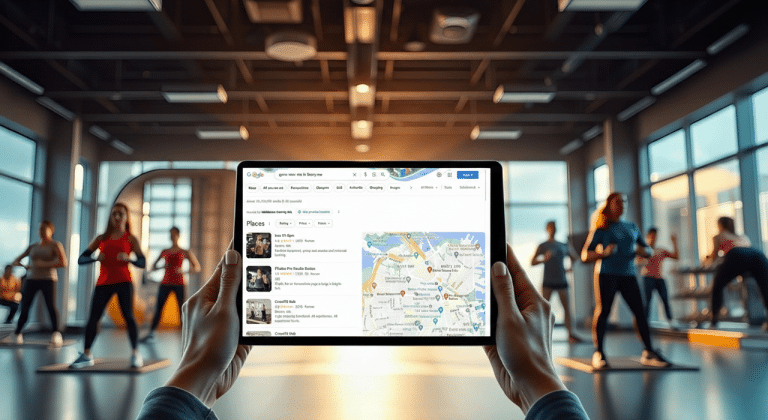
Citations are online mentions of your business name, address, and phone number. They validate your business exists and operates in your claimed location.
Core citation sites
Submit your business to these essential directories first:
General:
- Yelp
- Yellow Pages
- Bing Places
- Apple Map
- Foursquare
Fitness-specific:
- Local gym directories
Local:
- Chamber of Commerce
- Local business associations
- City/neighborhood directories
- Local news sites with business listings
Finding citation opportunities
Check competitors:
Where are ranking competitors listed? Use their citations as a roadmap.
Local search:
Google “personal trainers in [your city]” and see which directories appear in results.
Managing citations
Claim existing listings:
Search for your business name across directories. You may find listings you didn’t create. Claim and optimize them.
Monitor for errors:
Quarterly, audit your top citations ensuring information remains accurate.
Remove duplicates:
Multiple listings for the same business confuse Google. Consolidate or remove duplicates.
Generating and managing client reviews
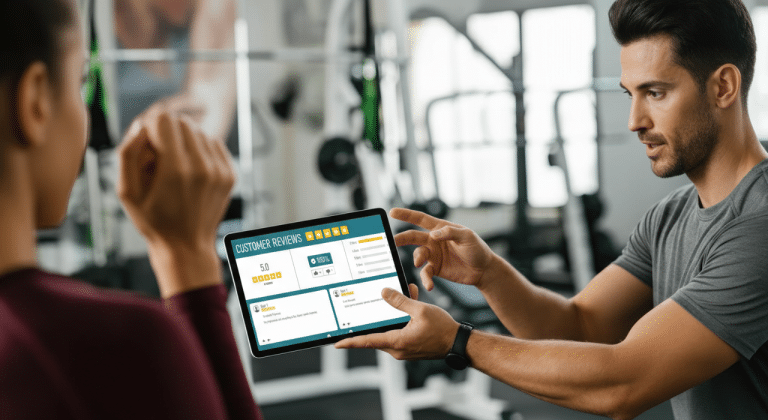
Reviews are social proof, trust signals, and ranking factors combined. For local SEO, they’re non-negotiable.
Why reviews matter
Ranking impact:
Google uses review quantity, recency, velocity (rate of new reviews), and ratings as ranking factors
Click-through impact:
Businesses with 4+ stars get significantly more clicks than lower-rated competitors.
Conversion impact:
93% of consumers read online reviews before making purchases.
The review generation system
Don’t just hope clients leave reviews. Build a system.
Timing:
Ask when clients are happiest, after achieving a new personal best, milestone, or visible result.
Method:
Make it incredibly easy:
- 1. Send direct link to your Google review page
- 2. Provide simple instructions
- 3. Personalize the ask
Sample request message:
“Hey [Name]! Congrats again on hitting your [milestone]! Your hard work is paying off! If you’re happy with your training experience, would you mind sharing a quick review on Google? It helps me reach more people who need the same support you’ve gotten. Here’s the link: [direct review link]. Takes 2 minutes. Thanks so much!”
Timing formula:
- Wait 2-4 weeks after starting training (enough experience)
- Ask after significant wins
- Request 1-2 reviews monthly (steady flow better than batches)
Responding to reviews
Respond to every review:
- Thank positive reviewers specifically
- Address negative reviews professionally
- Include location keywords naturally
Positive review response template:
“Thanks so much, [Name]! It’s been great working with you toward your [specific goal]. I’m proud of the progress you’ve made in [timeframe]. Looking forward to continuing your training here in [neighborhood/city]!”
Negative review response:
- Don’t get defensive
- Acknowledge their concern
- Offer to discuss privately
- Show potential clients you care about resolution
“I’m sorry to hear about your experience, [Name]. Client satisfaction is incredibly important to me. I’d like to understand what happened and make things right. Please email me at [email] or call [phone] so we can discuss this further.”
Review platforms
Priority order:
- 1. Google (most important for local SEO)
- 2. Facebook (social proof, shows in search results)
- 3. Yelp (if active in your area)
- 4. Industry-specific platforms
Focus efforts on Google first. Once you have 20+ Google reviews, expand to other platforms.
What to never do
Priority order:
- Buy fake reviews (Google will penalize you)
- Write reviews for yourself
- Offer incentives for positive reviews (violates Google’s policy)
- Delete negative reviews (address them instead)
- Ask clients to remove negative reviews and repost positive ones
Related article: How to use client reviews/testimonials/case studies ethically to build credibility and attract new clients
Creating location-specific content

Content targeting local searches brings qualified traffic and demonstrates local expertise.
Blog post ideas with local angles
Neighborhood workout guides:
“Best Outdoor Training Spots in [Neighborhood]” “[City] Hiking Trails for Fitness Training”
Local event coverage:
“Training Tips for [City’s] Marathon Runners” “Preparing for [Local] 5K: 6-Week Training Plan”
Seasonal local content:
“Staying Fit During [City] Winters” “Summer Training in [City]: Beat the Heat”
Local client features:
“How [Name] Lost 40 Pounds Training in [Neighborhood]” (with permission)
Community involvement:
“Partnering with [Local Charity] for Fitness Fundraiser” “Free Training Session at [Local Park] This Saturday”
Optimization for local content
Each post should include:
- City/neighborhood name in title
- Location references in first paragraph
- Local landmarks or references
- Link to location page on your site
- Call-to-action for local readers
Content formats beyond blog posts
Video:
- Training sessions at local parks
- Client testimonials mentioning neighborhood
- Quick workout demos with local landmarks visible
Social media:
- Check-ins at local locations
- Tag local businesses you work with
- Use location-specific hashtags (#[City]Fitness, #[Neighborhood]PersonalTrainer)
Email newsletter:
Local fitness events calendar, community features, neighborhood-specific tips.
Local link building strategies

Links from local websites signal to Google that you’re an established local business.
Local link opportunities
Local media:
- Pitch fitness stories to local news sites
- Offer expert quotes on fitness topics
- Submit press releases for events or milestones
Local business partnerships:
- Gyms or studios (if you rent space or collaborate)
- Nutritionists or physical therapists (complementary services)
- Local sports teams or running clubs
- Corporate wellness programs
Community involvement:
- Sponsor local sports teams (listed on their website)
- Participate in charity events (event websites link to sponsors)
- Join Chamber of Commerce (member directory links)
Guest content:
- Write for local blogs or publications
- Contribute to community newsletters
- Appear on local podcasts
The outreach approach
Don’t just ask for links. Provide value.
Template:
“Hi [Name], I’m [Your Name], a personal trainer based in [City]. I noticed you recently published [article about local topic]. I loved [specific thing you liked].
I recently wrote a comprehensive guide on [related topic] that your readers might find valuable: [link]. If you think it would be a good fit, I’d be honored if you’d consider mentioning it in a future post or resource roundup.
Either way, keep up the great work covering [City] [topic]!”
Quality over quantity
One link from a respected local news site beats 50 links from random directories. Prioritize:
- Local authority sites
- Relevant local organizations
- Sites your potential clients actually visit
Mobile optimization for local search

60% of local searches happen on mobile devices. If your site doesn’t work well on phones, you’re invisible to most local searchers.
Mobile essentials
Responsive design:
Your website must adapt perfectly to all screen sizes. Test on actual phones, not just browser resize tools.
Fast loading:
Most mobile users abandon sites that take more than 3 seconds to load.
Speed optimization:
- Compress images
- Minimize code
- Use browser caching
- Choose fast hosting
Click-to-call:
Make your phone number clickable. Mobile users should tap once to call you.
Simple navigation:
Big buttons, clear menus, minimal scrolling to find information.
Local information above the fold:
Don’t make mobile visitors scroll to find your location or contact info.
Mobile-specific local features
Google Maps integration:
Embed maps on location pages so mobile users can instantly get directions.
“Get Directions” button:
Direct link to Google Maps with your address pre-filled.
Mobile-friendly forms:
Simple contact forms optimized for phone typing, minimal required fields, large input boxes.
Tracking your local SEO performance

You can’t improve what you don’t measure. Track these metrics monthly.
Rankings
Google Search Console:
- Free tool showing which searches bring you traffic
- Filter by location to see local performance
- Track impressions and clicks for local keywords
Manual searches:
- Regularly search your target keywords in incognito mode
- Note your position in results
- Check competitors’ positions
Target keywords to track:
- “personal trainer [city]”
- “personal trainer near me” (use location-specific search)
- “[specialty] trainer [city]”
- “[neighborhood] personal training”
Traffic
Google Analytics:
- Organic search traffic trends
- Which pages get the most local traffic
- Geographic location of visitors
- Conversion rate from local traffic
Goals to set up:
- Contact form submissions
- Phone calls
- Free consultation bookings
Google Business Profile insights
Track within your Google Business Profile dashboard:
- Profile views
- Search queries
- Actions (calls, direction requests, website clicks)
- Photo views
- Comparison to similar businesses
Review metrics
- Total number of reviews
- Average rating
- Review velocity (new reviews per month)
- Review platforms distribution
Monthly reporting template
Create simple spreadsheet tracking:
- Date
- Google ranking for primary keywords
- Total reviews (Google)
- Google Business Profile views
- Website sessions from organic/local search
- Contact form submissions
- New clients from local search
Trends matter more than individual months. Look for consistent improvement over 3-6 month periods.
Common local SEO mistakes to avoid

Don’t sabotage your efforts with these frequent errors.
Inconsistent NAP
Every variation of your address or phone number creates confusion. “123 Main St” vs “123 Main Street” seems minor but dilutes your local SEO signal.
Fix: Choose one format, document it, use it everywhere.
Ignoring Google Business Profile posts
Many trainers set up their profile and never touch it again. Active profiles rank higher.
Fix: Post weekly. It takes 5 minutes.
Only having reviews on one platform
Diversified reviews look more legitimate and capture searchers on different platforms.
Fix: Systematically request reviews on Google first, then Facebook, then other platforms.
Buying links or citations
Low-quality, spammy links actively hurt your rankings.
Fix: Focus on legitimate, relevant local links only.
Over-optimizing with keyword stuffing
“Best Personal Trainer Phoenix Personal Training Phoenix AZ Fitness Coach Phoenix” doesn’t work. Google is smarter than that!
Fix: Write naturally for humans. Mention location where it makes sense.
Not claiming existing citations
Your business may already be listed in directories you never created. If unclaimed, information may be wrong.
Fix: Regularly Google your business name + city and claim any listings found.
Duplicate location pages
Creating 10 identical pages and just changing the city name = thin content. Google may penalize you for this!
Fix: Only create location pages for areas you genuinely serve, with unique, valuable content for each.
Forgetting about mobile
If your site is difficult to use on mobile, local searchers bounce immediately.
Fix: Test your entire site on actual mobile devices monthly.
The bottom line on local SEO
Local SEO isn’t complicated. It just requires consistent effort across fundamentals most trainers ignore.
The trainers dominating local search results six months from now:
- Completely optimized Google Business Profiles
- 20+ positive Google reviews
- Clean, consistent citations across major directories
- Mobile-optimized websites with location-specific content
- Active engagement in local community and media
None of this requires technical wizardry or big budgets. Just systematic implementation and consistency.
Here’s a quick-start summary of your first steps:
- 1. Claim and fully optimize your Google Business Profile (if you do one thing, make it this)
- 2. Ask your three happiest clients for Google reviews
- 3. Ensure your website clearly mentions your location on the homepage
- 4. Verify your NAP is identical across your website, Google, and social media
- 5. Submit your business to Yelp and Yellow Pages with complete information
Then, monthly:
- Request 2-3 new Google reviews
- Post to Google Business Profile weekly
- Create one piece of location-specific content
- Check and update one citation
Six months of this? You’ll dominate local search in your area. Most competitors won’t even start.
Ready to convert local search traffic into paying clients?
Ranking in local search brings visitors. Converting them into clients requires professional systems and seamless user experience.
My PT Hub helps you turn local search traffic into booked training sessions:
Professional branded presence with a MySite custom landing page showcasing your services. Seamless booking and payment processing so local leads can instantly onboard. Automated client communication keeping leads engaged from first contact through their training journey. Mobile-optimized client experience that works perfectly for the 60% searching on phones.
Start your 30-day free trial of My PT Hub today and discover how the right software helps you adopt valuable trends while filtering out the noise.