
If you’re a personal trainer or fitness coach thinking about developing your own fitness app, you’ve probably asked yourself this question. And the answer, depending on which path you take, ranges from genuinely affordable to eye-wateringly expensive.
Building a fitness app from scratch is one of the most common aspirations in the coaching industry. Having your brand on a client’s home screen, delivering workouts, tracking progress, and processing payments through your own app sounds like a serious step up. And it is. But the custom development route comes with a price tag that most trainers simply aren’t prepared for.
The good news is there’s a smarter way to get there. In this article, we’ll break down exactly what it costs to build a fitness app independently, from initial development right through to ongoing maintenance, and then contrast that with what’s possible through My PT Hub’s white label app option. The difference might surprise you.
Contents:
- 1. Why personal trainers want their own app
- 2. The cost of building a fitness app from scratch
- 3. Hidden ongoing costs you need to factor in
- 4. What you actually get for that investment
- 5. The white label alternative: your app, without the build cost
- 6. My PT Hub’s white label and custom branded app options
- 7. Which option makes sense for you?
Why personal trainers want their own app
Having your brand on a client’s phone is more than just a nice touch. It builds credibility, keeps your business top of mind, and creates a polished end-to-end experience that sets you apart from coaches still delivering workouts via PDF or WhatsApp. Clients who train through a branded app tend to feel more connected to the business and more accountable to their programs.
It also signals professionalism. When someone downloads “Paul’s Fitness” from the App Store, your coaching business feels like a real product, not just a side hustle. That perception matters, both for retention and for charging premium prices.
Related article: 13 fitness branding tips to stand out online
The cost of building a fitness app from scratch
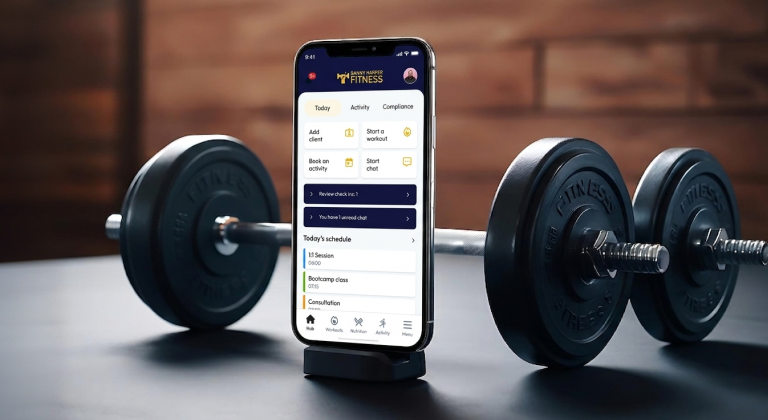
Let’s look at what building a fitness app independently actually costs, because the numbers tend to shock people who haven’t looked into it before.
Initial development costs
The build cost for a fitness app varies widely depending on the features you need, the platform (iOS, Android, or both), and who you hire to build it. Here’s a realistic breakdown based on industry benchmarks:
A basic fitness app with core features like user profiles, workout logging, and progress tracking can cost anywhere from $25,000 to $60,000+. A mid-range app with nutrition tracking, wearable integrations, in-app messaging and payment processing could range from $60,000 to $150,000. A fully featured coaching platform with AI personalization, live streaming, community features, and advanced analytics can cost $150,000 to $500,000 (or even more!).
For most personal trainers, the mid-range build is the realistic target: a client-facing app with workouts, nutrition, messaging, booking, and payments. That’s a $60,000 to $150,000 investment before you’ve coached a single session through it.
Several factors push the development budget higher:
Building for both iOS and Android simultaneously adds significant complexity. Wearable integrations (Apple Health, Google Fit, Fitbit, Garmin) each require additional development time. Video libraries and exercise databases need to be built, stored, and served at scale. Payment processing, onboarding flows, and client-facing dashboards all require careful UX design. And developer rates vary enormously by region.
Design and testing
UI/UX design is often underestimated. A well-designed app that clients actually want to use requires wireframes, prototypes and multiple rounds of testing across devices. This phase alone could add $10,000 to $40,000 to the total.
Quality assurance testing to catch bugs and ensure the app works correctly across different devices and operating systems adds another $5,000 to $20,000.
Hidden ongoing costs you need to factor in

The build cost is only the beginning. Once your app is live, you’ll face a steady stream of ongoing expenses that most people don’t account for when they’re planning.
Annual maintenance and updates
Apps need continuous maintenance to stay functional. Every time Apple or Google releases a major OS update, your app needs to be updated to stay compatible. Security patches, bug fixes, performance improvements and new feature development all require developer time.
Annual maintenance costs typically range between 15% to 25% of the initial development cost. For a $100,000 app, that’s $15,000 to $25,000 per year, every year, just to keep the lights on.
App store fees and compliance
Apple charges a $99 annual fee for the Apple Developer Program. Google Play is a one-time $25 registration fee. These are small on their own, but factor in that Apple and Google also take a 15% to 30% commission on any in-app purchases or subscriptions processed through the app, and the cost of doing business adds up really quickly.
Cloud hosting and infrastructure
Your app’s backend needs servers, databases, and storage. Cloud hosting costs scale with usage, starting at around $100 per month for a small user base and rising to $1,000 to $10,000 per month as your client numbers and content library grow.
Content and support
If your app includes an exercise video library, you’ll need to create, film, edit and regularly update that content. That’s either your time, or someone else’s money.
The realistic total picture
Take a $100,000 mid-range app build. Add $20,000 per year in maintenance, $5,000 per year in hosting, and ongoing content costs. Within three years, you’ve spent $160,000 or more, and that’s assuming nothing goes seriously wrong. Rebuilding or adding major features can trigger another significant development cost.
For most independent personal trainers and coaching businesses, this investment doesn’t make financial sense, especially when there’s much a smarter alternative.
What you actually get for that investment

A fully custom-built app does give you complete control. You can build exactly the features you want, in exactly the order you want them. Your app is entirely your own product.
But that level of control also means you’re responsible for everything. Every bug, every compatibility issue, every feature request from clients, every App Store review that demands a change. You need a development team you can call on regularly, and that relationship costs money and time whether or not you’re actively building new features.
For trainers whose core business is coaching clients, not running a software product, that burden is rarely worth the benefit.
The white label alternative: your app, without the build cost
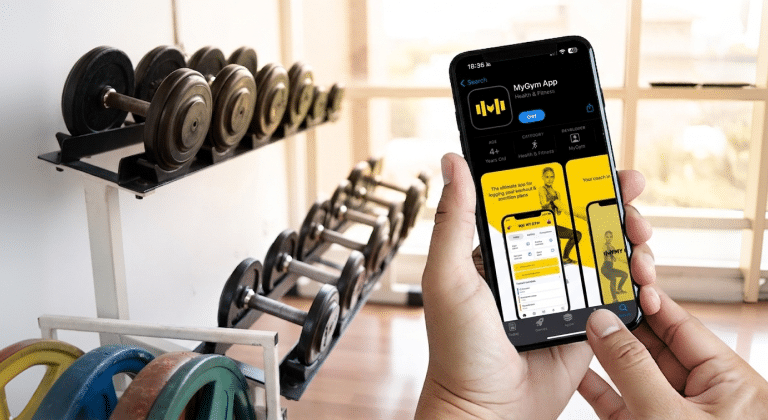
A white label fitness app built by My PT Hub gives you almost all of the advantages of an independently developed fitness app: you’ll get a fully branded, professional client experience (with your own app in the App Store and Google Play Store), without the six-figure development budget or the ongoing technical overhead.
With a white label solution, you’re essentially licensing a fully built, maintained, and updated platform and putting your brand on it. The infrastructure, the exercise library, the wearable integrations, the payment processing: all of it is already built. You just customize the look and feel, add your logo, and deliver coaching through it.
The trade-off is that you don’t have complete control over the feature roadmap. But for most trainers, the features they actually need are already there, and new ones are added regularly without any cost or development effort on their part.
Related article: How to choose the right personal training software
My PT Hub’s white label and custom branded app options
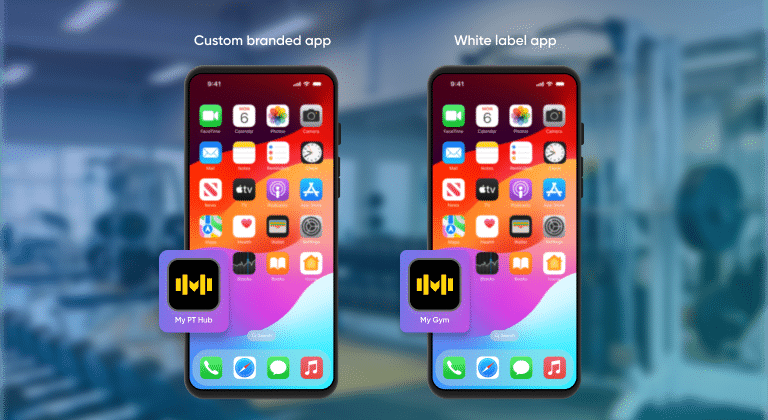
My PT Hub offers two branded app options for personal trainers and fitness coaches, both of which sit at a fraction of the cost of custom development.
Custom branded app
The Custom branded app add-on lets you replace the My PT Hub app icon with your own logo and brand colors across all trainer and client devices, on both iOS and Android. Clients download the My PT Hub app from the App Store or Google Play, but once they log in, they see your branding, not ours. It’s available to My PT Hub subscribers for a one-time fee, and the build process is handled entirely by the My PT Hub Apps Team, typically taking two to four weeks from logo submission to go-live.
No developer accounts to manage, no App Store submissions to wrestle with, and no technical knowledge required.
White label app
The White label app goes a step further. Your app gets its own name, its own App Store and Google Play listing, and a fully branded end-to-end experience that reflects your business at every touchpoint. Clients search for your business name in the App Store and download it directly. From onboarding to workout delivery to messaging, everything they see is yours.
The White label app is available for a monthly fee for My PT Hub Premium subscribers, and most apps are live within four to six weeks of setup. The My PT Hub Apps Team guides you through every step, including setting up developer accounts.
Critically, every platform update, new feature, and infrastructure improvement that My PT Hub releases automatically applies to your white label app. You never have to commission a development sprint to add wearable integrations or improve your check-in flow. It just happens.
What’s included in My PT Hub’s platform
Whether you use the Custom branded app or the White label app, your clients get access to a feature set that would cost six figures to build independently:
A workout builder with access to 8,000+ HD exercise videos, nutrition planning and the world’s largest verified nutrition database, automated check-ins and client messaging, progress photo storage and metrics tracking, wearable integrations including Apple Health, Google Fit, Fitbit, and Garmin, community features, secure payment processing, and AI-powered check-in analysis to reduce your admin time.
All of that is built, maintained, and updated by My PT Hub’s engineering team. You coach, while we handle all the tech.
Related article: Top AI tools for personal trainers
Which option makes sense for you?
If you’re an established coaching brand with significant revenue, a highly specific feature set that no existing platform can deliver and the budget and appetite to manage an ongoing software product, custom development might be justified. It’s a serious investment with real trade-offs, but it’s not impossible.
For the vast majority of personal trainers and fitness coaches, the white label or custom branded app route through My PT Hub is the smarter move. You get a professional, branded client experience live in weeks, not months. You avoid the six-figure upfront cost and the ongoing maintenance burden. And you can put your energy into growing your coaching business rather than managing a development team.
Ready to get your own branded fitness app without the $100,000+ price tag? Start your 30-day free trial of My PT Hub and see how easy it is to deliver a fully professional, branded coaching experience to your clients from day one.