
How many clients should a personal trainer have? It’s one of the most common questions in personal training, and frustratingly, there isn’t any one single answer. The right number of clients for you depends on your business model, your income goals, how you deliver your coaching, and honestly, how much of your sanity you’d like to keep. Some trainers thrive with 10 dedicated one-on-one clients. Others run successful businesses with 50 or more through online and group coaching.
This guide breaks down the key factors that influence how many clients a personal trainer should have, what the numbers typically look like across different models, and how to figure out the right capacity for your specific business.
Contents:
- 1. What does “number of clients” actually mean?
- 2. The in-person trainer: realistic client capacity
- 3. The online trainer: a very different equation
- 4. The hybrid model: getting the best of both
- 5. How your income goals should drive your client numbers
- 6. The hidden cost of too many clients
- 7. How to calculate your personal capacity
- 8. Signs you’ve hit your limit (and what to do about it)
- 9. How to serve more clients without burning out
What does “number of clients” actually mean?

Before getting into numbers, it’s worth clarifying that the number of clients you can physically manage depends entirely on the style of your coaching setup. For example, a client you see three times a week in person takes up vastly more of your time than a client on a monthly online coaching subscription. Group training clients are different again. Lumping all of these into one number doesn’t tell you much.
So throughout this guide, when we talk about client numbers, we’ll be specific about the model. The right number of clients for an in-person trainer working one-to-one is different from the right number for an online coach running semi-automated programs. Both are valid; they just need to be calculated differently.
The in-person trainer: realistic client capacity

For personal trainers delivering one-to-one sessions in person, the average tends to sit somewhere between 15 and 25 active clients.
A full-time trainer working five days a week with a typical split of morning and evening peak hours has a relatively fixed number of bookable slots. Most clients train two to three times per week. Factor in your own travel time, session prep, admin and the fact that you can only realistically deliver quality coaching for so many hours before fatigue sets in, and 20 clients is a healthy full load for a solo trainer working in-person.
Some in-person trainers operate at higher numbers by keeping sessions tightly packed and minimizing admin, while others deliberately stay at 10 to 15 clients and charge a premium rate per session. Neither approach is wrong. They reflect different business priorities.
If you’re working within a gym environment and picking up clients from the gym floor, you might build quickly to 20 or more. If you’re building a premium brand targeting high-value clients, 12 to 15 at a higher price point might deliver the same revenue with a better quality of life.
The online trainer: a very different equation

Online coaching changes the numbers significantly. Because you aren’t physically present for each session, the time you spend per client looks different. You’re typically spending time on programming, reviewing check-in data, sending feedback, updating plans and communicating through your coaching software, rather than being on the gym floor for 60-minute blocks.
This means online coaches can often manage many more clients than their in-person counterparts. This can be anywhere from 20 to 50+ clients for a solo online trainer, depending on how much you automate through your online personal training app and the level of support you offer.
A high-touch online coaching model; one involving weekly video calls, detailed check-ins, and fully custom programs, sits closer to the lower end of that range. A more template-based subscription model with strong systems and automation can easily reach the triple digit mark.
The key variable with online coaching is the efficiency of your systems. If you’re building programs from scratch each week, manually chasing check-ins, and managing client communication through a patchwork of WhatsApp, spreadsheets, and email, you’ll hit your ceiling fast. If you’re using a dedicated personal training software like My PT hub that centralises programming, check-ins, progress tracking, and messaging, you can extend your capacity meaningfully without sacrificing quality.
Related article: How to become an online personal trainer: Step-by-step guide
The hybrid model: getting the best of both worlds

Most trainers today operate some version of a hybrid model; in-person sessions with some clients, online coaching with others. This is increasingly the norm, and for good reason. It diversifies your income, gives you more flexibility, and removes the ceiling that comes with purely in-person work.
The capacity question for hybrid trainers is really about balance. If you have 15 in-person clients and want to add online coaching on top, how much do those in-person sessions leave in the tank for program design, check-ins, and communications? The answer depends on how efficiently you’re operating.
A reasonable starting point for a hybrid trainer is 15 in-person clients paired with 10 to 20 online clients, provided you have solid systems in place for the online side. Many trainers scale their online roster over time as they refine their delivery and reduce per-client admin.
Related article: 5 Benefits of offering hybrid training as a personal trainer
How your income goals should drive your client numbers

Here’s a practical way to approach the client number question: start from your income target, not an arbitrary client count.
The formula is straightforward. Take your target monthly income, divide it by your average revenue per client per month, and you have the number of clients you need. That’s your minimum target, not your maximum capacity.
For example:If your target is $5,000 per month and your average client pays $250 per month, you need 20 clients. If your average client pays $400 per month (through a higher-ticket package or premium in-person sessions), you only need 12 or 13.
This framing is useful because it shows that growing your client count isn’t the only lever available to you. Raising your prices, improving retention, or adding recurring revenue streams can reduce the number of clients you need to hit your goals.
Related article: How to create recurring revenue for your personal training business: the ultimate guide, How to increase lifetime value (LTV) of personal training clients
The hidden cost of having too many clients

Taking on more clients than you can properly service is one of the most common mistakes trainers make, and the consequences go beyond just feeling tired.
When you’re overstretched, the quality of your coaching tends to drop before you even notice it. Programs become less individualised. Check-ins get shorter or less frequent. Clients start to feel like they’re getting a generic service rather than a personalised one. Results suffer. Retention drops. You end up on a treadmill of constantly replacing churned clients rather than building a stable base.
There’s also the personal cost. Personal trainer burnout is real, and it’s one of the industry’s biggest drivers of career exit. Training is physically and emotionally demanding work. Seeing client after client without adequate recovery, admin time, or rest leads to a deterioration in your performance and your passion for the job.
The goal isn’t to have as many clients as possible. It’s to have the right number of clients that lets you deliver excellent coaching, run a sustainable business and avoid grinding yourself into the ground.
Related article: Burnout in personal training: warning signs and how to protect your mental health
How to calculate your personal capacity

Rather than working from industry averages, it’s worth calculating your own realistic capacity. Here’s a simple framework.
First, identify your available working hours per week. Be honest; include only the hours you’re genuinely willing to commit to, not your theoretical maximum.
Next, estimate how much time each client actually requires per week. For an in-person client, this includes session time, travel or setup time and any programming or admin time. For an online client, this means programming time, reviewing check-ins, and responding to messages. For in-person one-to-one clients is around 1.5 to 2 hours per client per week once all the surrounding tasks are included. Online clients on a well-systemised model might take up just 30 to 60 minutes of your time per week.
Finally, reserve a portion of your working hours for non-client tasks: marketing, admin, professional development and genuine breaks for your personal life. Leaving no buffer is a fast route to burnout.
Divide your available client-facing hours by your estimated time per client, and you have a rough capacity ceiling. Build toward that ceiling gradually rather than trying to hit it immediately; quality of delivery matters more than raw numbers, especially when you’re growing.
Signs you’ve hit your client limit (and what to do about it)

Some common indicators that you’re carrying more clients than your system can handle:
- You’re consistently running late or cutting sessions short.
- You can’t recall the details of a client’s goals or progress without checking your notes each time.
- Your programming has become noticeably more generic.
- Clients are dropping off at a higher rate than usual.
- You’re skipping your own training or sleep to keep up.
If several of these ring true, it’s worth pausing before taking on more clients. The fix isn’t always to drop clients; often it’s to improve your systems, reduce per-client admin and create more capacity without shrinking your roster.
How to serve more clients without burning out
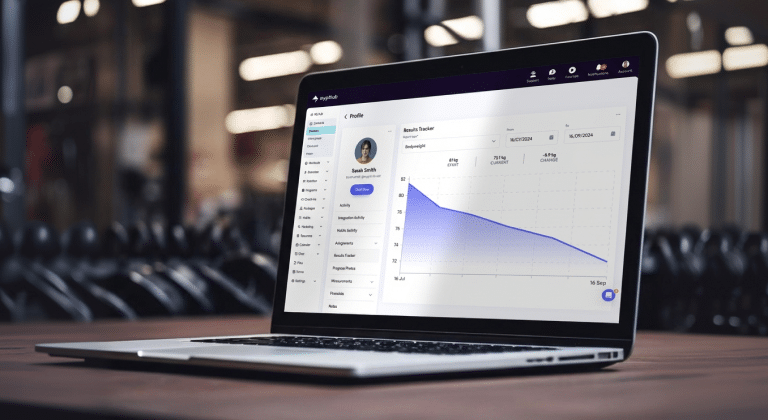
The most effective way to increase your client capacity sustainably is through better systems and smarter use of technology, not just working more hours.
Templated programming that can be customised quickly rather than built from scratch saves significant time per client. Automated check-in processes remove the need to manually follow up every week. Centralised client communication through a coaching app reduces the time lost switching between WhatsApp, email and spreadsheets. Group coaching elements, even small ones, let you deliver value to multiple clients at once.
My PT Hub is built to help trainers do exactly this. With tools for automated check-ins, custom programs, client progress tracking, nutrition coaching, and payment management all in one platform, it reduces the admin burden per client significantly; which means you can take on more clients without compromising the quality of what you deliver.
Related article: Fitness tech stack 2026: Tools every personal trainer should, 10 ways to generate passive income as a personal trainer
Find your ideal client number and build toward it
There’s no universal answer to how many clients a personal trainer should have. The right number is the one that lets you deliver excellent results, hit your income goals and sustain your energy and passion over the long term.
Start with your income target, build your capacity calculation honestly, invest in systems that reduce per-client admin and scale gradually. That approach will serve you far better than chasing a headline number.
If you want to tighten up your operations and build the kind of systems that support a full, well-managed client base, start your 30-day free trial of My PT Hub today and see how much easier managing your business becomes.